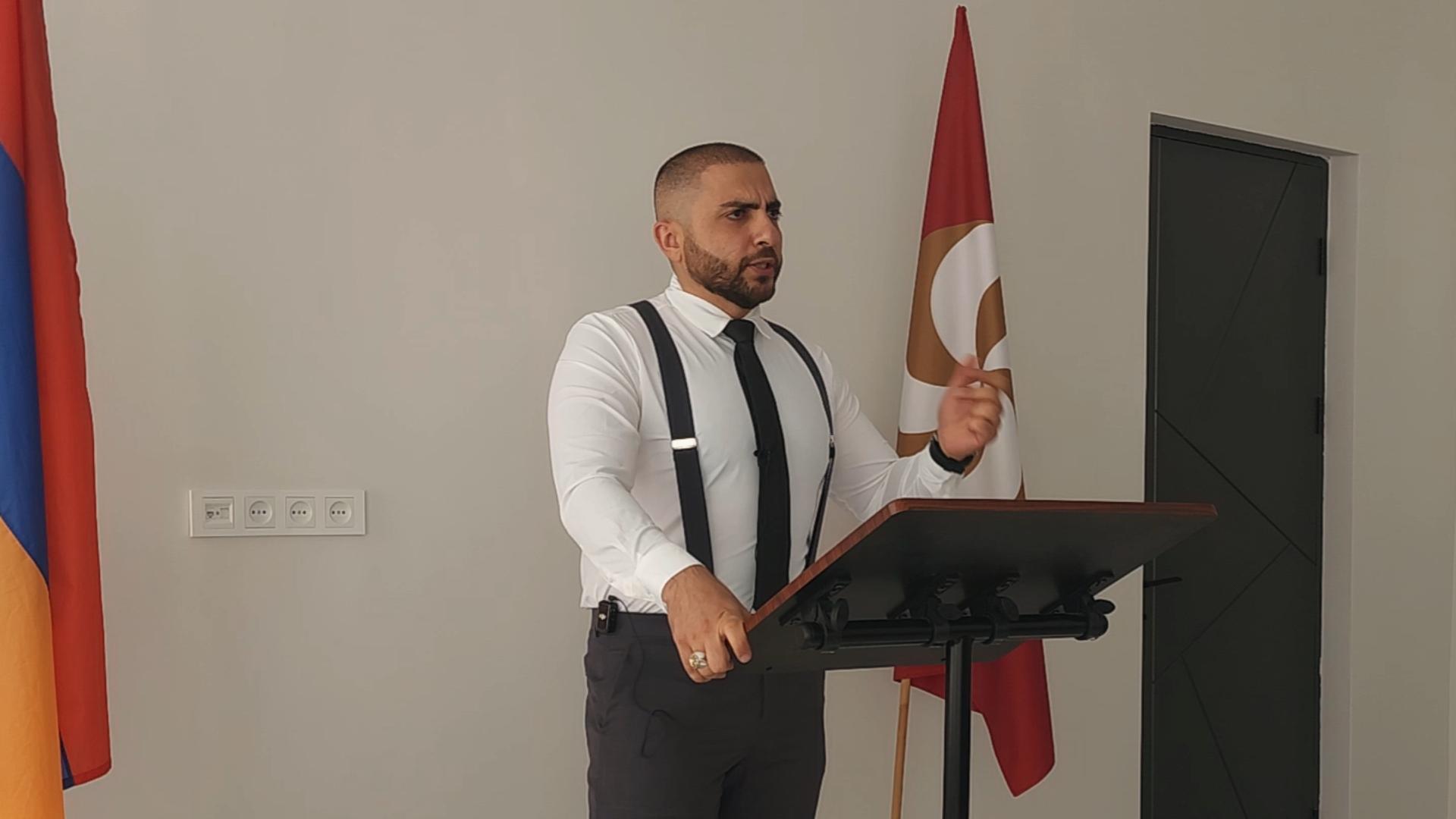
Hayk Nazaryan - Speech #13 with English subtitles - At Hosank's meeting (13-09-2025)
03:00:00 13.09.2025
Speech 13
At the meeting
In the last several meeting I pointed out what the main internal reasons on why we lost the 44-day treacherous war. We talk about that shameful defeat often because it is of central importance to our recent history. After that defeat many masks were torn off and everything became much clearer. November 9, 2020 also became the day when we once again turned from a victorious nation into a defeated one, when a victorious mindset was replaced by a defeatist and servile mentality.
Of course, as I have already said, the present anti-Armenian government is not solely to blame, because those so-called “former” traitors ran a de-nationalizing policy for years that made the handing over of Artsakh easier for the “current” ones. For that reason they do not contradict each other — on the contrary, they complement one another very well, because both are simply two different masks of the fifth column of neo-Bolshevism operating in Armenia.
Without going too deep, we can fairly easily see how their policies and defeatist stance brought us to this humiliating and degraded state. And we cannot properly understand what is happening to us today if we do not clearly understand what happened during the war in particular.
However, I think it is not entirely correct to place all the blame on the government and the fake opposition, because as a nation we share a portion of the guilt, and that is what I want to speak about today. Naturally, blaming the entire nation is not entirely logical, because it is the government’s responsibility to educate the nation correctly, but nonetheless we must recognize our mistakes.
First, we can start from the fact that for years we underestimated our enemies and often mocked them, while they took us very seriously. You yourselves will remember well that we constantly called the Azerbaijanis “sheep” and often depicted them as sheep in cartoons, while the Azerbaijanis never did the same to us. On the contrary, they constantly called us “terrorists” and “fascists” and always portrayed us as monsters.
The interesting thing is that they continue to say the same things about us and portray us the same way even after their victory in this war. In other words, they did not make the mistake we made after our victory in the Artsakh liberation war. They understand well that one must not underestimate the enemy — especially an enemy like us who, with fewer material and human resources, had destroyed and driven their forces out of Artsakh 31 years ago. I have said many times that they know us better than we know ourselves, and for that reason from the very beginning of November 9, 2020 they continued to take us seriously — despite the fact that, sadly, we still have an incompetent, weak and laughable leadership. They do not want to repeat the crude mistake we committed. We must put our egos aside and admit that our enemies were wiser and more far-sighted on this matter than we were.
If the tyrant in Baku did not consider us a threat now, he would not continue labeling us “fascists,” shake his fist at us and try to harvest the fruits of his victory as quickly as possible. This is a golden opportunity for him because the Armenian nation continues to sleep and lives under illusions of peace. It is ironic that they still call us terrorists and fascists while they themselves continue to threaten our country and reward those who behead Armenian soldiers. They are intent on establishing their complete dominance over our Fatherland — continuing their anti-Armenian and expansionist policy — while our incompetent and treacherous government hypnotizes our people with false peace slogans.
They consistently work to transform the Republic of Armenia into so-called “Western Azerbaijan,” arming themselves relentlessly, while our neo-Bolshevik government sanctifies the current borders of Armenia — which are essentially the Soviet borders — and continues, step by step, to meet the demands of the Baku tyrant. This is the price we pay for underestimating our mortal enemies.
Our second mistake was that we overestimated our own strength and capabilities, which is the other side of underestimating the enemy. For a long time we believed that the Armenian soldier would fight to the end in wartime regardless of whether he had military training or not, whether he was mentally prepared or not. We thought that if we handed a weapon to an Armenian soldier and threw him into a trench, he would never abandon his position. But that was, in truth, the height of naivety.
During the war, of course, there were many brave Armenian heroes who performed great feats on the battlefield, but we must honestly admit that there were also many soldiers of the opposite sort who fled the battlefield at the slightest pretext. I assert this not only because I heard many such cases, but because during the days of war I saw with my own eyes four soldiers from our platoon flee on the very first day that the enemy began shelling the outposts near the village.
Many volunteered, but they did not take it seriously — thinking it would be a few days of fighting and then they would calmly return home. They went unprepared materially and mentally. We should long ago have realized that every soldier — active or reservist — must be prepared for such brutal battles. We must no longer place our hope only in the heroic spirit of the Armenian freedom-fighter, even though precisely that often saved us in history when for centuries we did not have an independent state. Our readiness must produce our ability to crush the enemy’s raiding bands. This, of course, applies not only to our army but to the armies of all states on earth.
We cannot make everyone a hero, but we can raise an overwhelming majority to be soldiers who perform duties and follow orders, even those who would run at the sound of a single shot in wartime.
Saying all this does not in any way justify the government and the general staff, because a large share of the blame rests with them. They were obliged to raise such soldiers and build such an army that these problems would arise rarely or not at all. Nor do I justify those who fled their positions, because for me that can never be acceptable.
Our third mistake, which I believe is among the greatest and most destructive, was that we continued to show provincial-minded patriotism despite having won independence 34 years ago. During the days of the war it became clearer to me that a significant portion of people in their hearts did not really consider Artsakh part of Armenia but rather viewed it as an entirely separate entity. And sadly it remains so to this day. For that reason the hearts of much of the Armenian people did not ache when Artsakh fell under the enemy’s occupation. It is sad that the Azerbaijanis considered Artsakh more theirs than we did, even though Artsakh has of course always been Armenian land.
One of the brightest examples of this provincial mentality is that at the front I often heard: “Why did I come from Armenia to fight in Karabakh, when there are Karabakhtis who went to Armenia to party?” Someone even said, “I will never take up arms again until the Turk comes to my village.” Such stupid thoughts and words angered me greatly, and I often argued with soldiers when I heard such things. I haven’t heard anything more anti-Armenian and anti-state than such expressions. Such words are devoid of logic and common sense and should never be tolerated in a future national state. I always answered them, “What if the Turks attacked Ijevan or Kapan and hundreds or thousands of people from Ijevan or Kapan fled to Yerevan, would that mean we should not defend Ijevan and Kapan with our lives?” They could not answer such questions because doing so would reveal their ignorance and hypocrisy.
By the same logic I, as a repatriate born and raised in the USA, could say: “Why did I move to Armenia if tens of thousands of Armenians emigrate?” or “Why did I come to the war if many run from the army?” Of course one must also consider that many say such things to justify their fear and tendency to flee, but in any case, even thinking or saying such things is not only cowardice but clear treachery.
We must eradicate this state-destroying provincialism if we want a truly patriotic society and state. A real patriotic soldier will deeply understand that his home is not limited to the four walls of his house, but includes the entire Fatherland: for him the Fatherland begins at every border position, and every lake, river, mountain and forest of the Fatherland is part of his home.
We must not look at how the person next to us thinks or what he does. We are obliged to take personal responsibility and fulfill our duties — to do what must be done for the development of our nation, the prosperity of the Fatherland and the strengthening of the state. We must do what is truthful and just, not invent cowardly excuses to avoid our duties. There is a well-known saying that characterizes all this well: “The inferior man argues about his rights, while the superior man imposes duties on himself.”
It is important that we learn from our mistakes and recognize our shortcomings so we can correct them — to be ready for the great crisis and difficult challenges that inevitably await us. We must not forget that history never forgives peoples who do not learn from their mistakes and are not ready to face its harsh trials.
Our destiny is in our hands: if we do not shape it, others will shape it for us. Real change begins with people like us, even if for now we are a minority. Every nation deserves its government, therefore let us become the change we want to see in our country so that we may have a government like the one we desire, build an army like the one we need, and forge a national state that will instill wisdom, courage and strength into our nation.
— Hayk Nazaryan
September 13, 2025