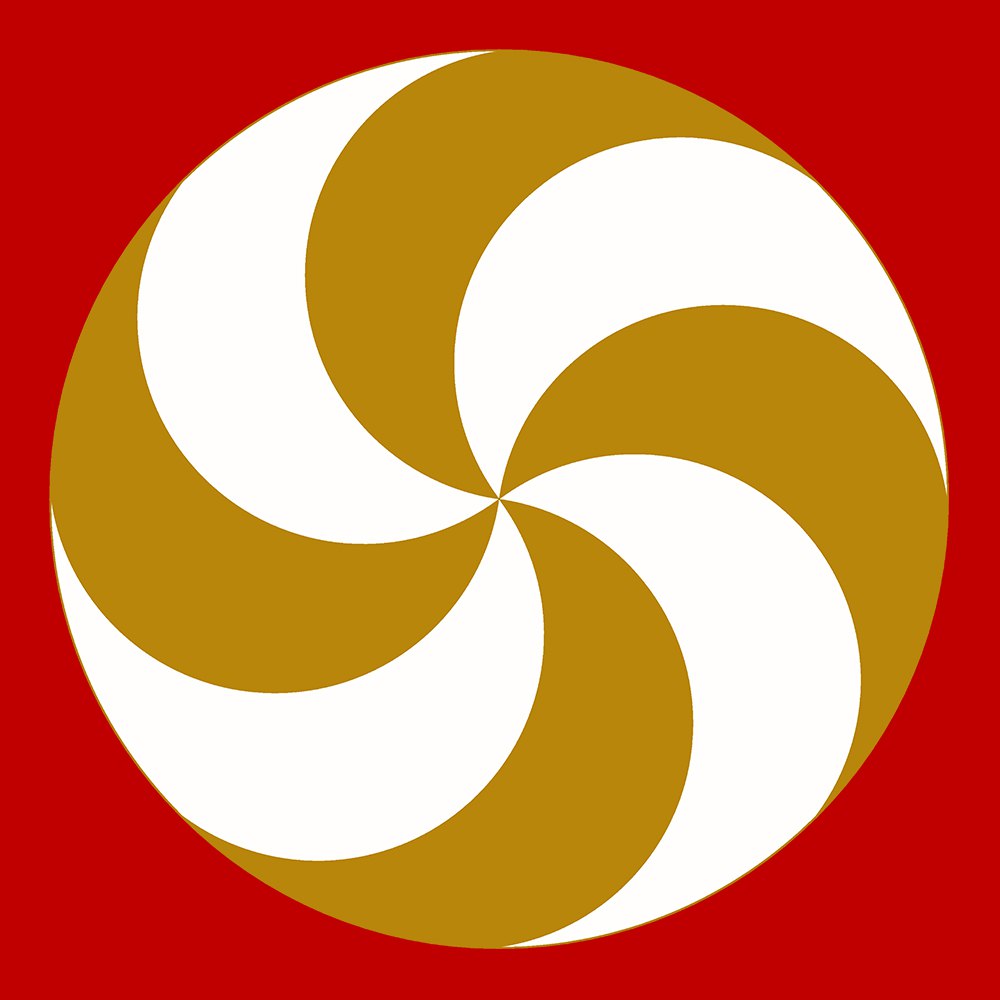
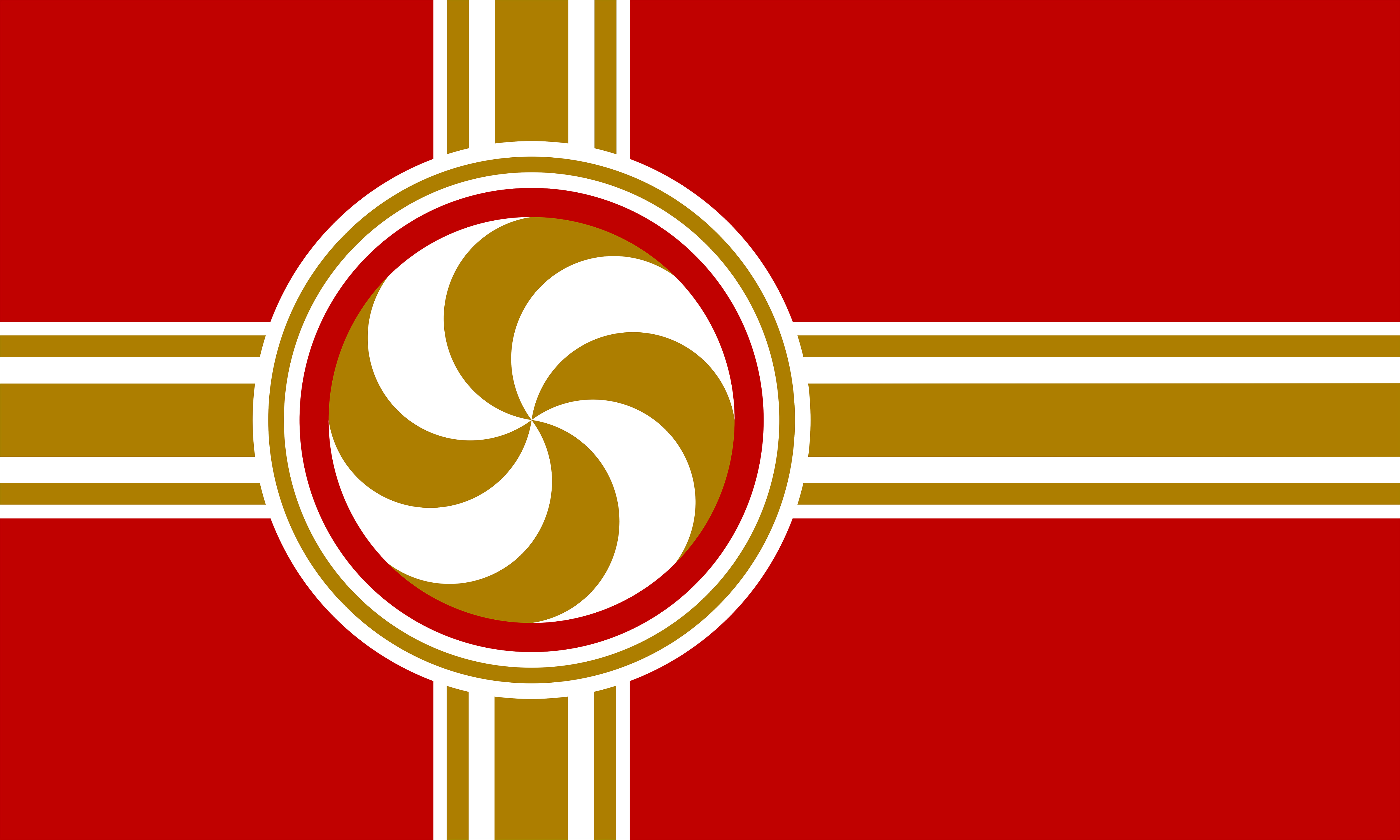
The symbol and flag of our Tseghakron movement, “Hosank”, is the Armenian eternity sign—rendered in gold and white—set against a dark red background. Through its galactic spirals, it represents the unity of two opposing forces in the universe, without which creation is impossible. The rotation of the eternity sign also reflects “Hosank” itself—the eternal motion of the race. The dark red symbolizes the blood of the race, the sacred link through which we connect to the Creator and the act of creation. The purer and more untainted the blood of the race, the more radiant its soul and the stronger its connection to the Divine. In other words, it is through our blood that we are bound to eternity.
The eternity sign has eight arms—four gold and four white—because the number eight is not only the most widespread symbol in Armenian culture, but also a number of great importance in mathematics and science. In mathematics, the number eight is the upright form of the infinity symbol (∞). We live in a four-dimensional reality (three axes plus time), but that reality consists of the “Sis” (micro) and “Masis” (macro) worlds. Their union forms an eight-dimensional space.
In the gold we see the noble values of our Aryan culture; in the white, our national ideals; and in the dark red, the blood spilled for the independence and prosperity of our fatherland. Within the eternity sign, we also see the victory of the eternal struggle for the development of our race. All this aligns with one of our slogans: “Honor Your Culture, Love Your Nation, Defend Your Fatherland.” The gold and dark red were also the royal colors of the Artaxiad dynasty of Armenia, particularly under Tigranes the Great, during whose reign Greater Armenia reached its zenith. The white was the color of the Bagratid dynasty and later the Armenian Kingdom of Cilicia—states that, through national struggle, restored our sovereignty. Thus, by combining our ancient royal colors with our invincible national symbol—the eternity sign—we will restore the glory and honor of our fatherland and state.
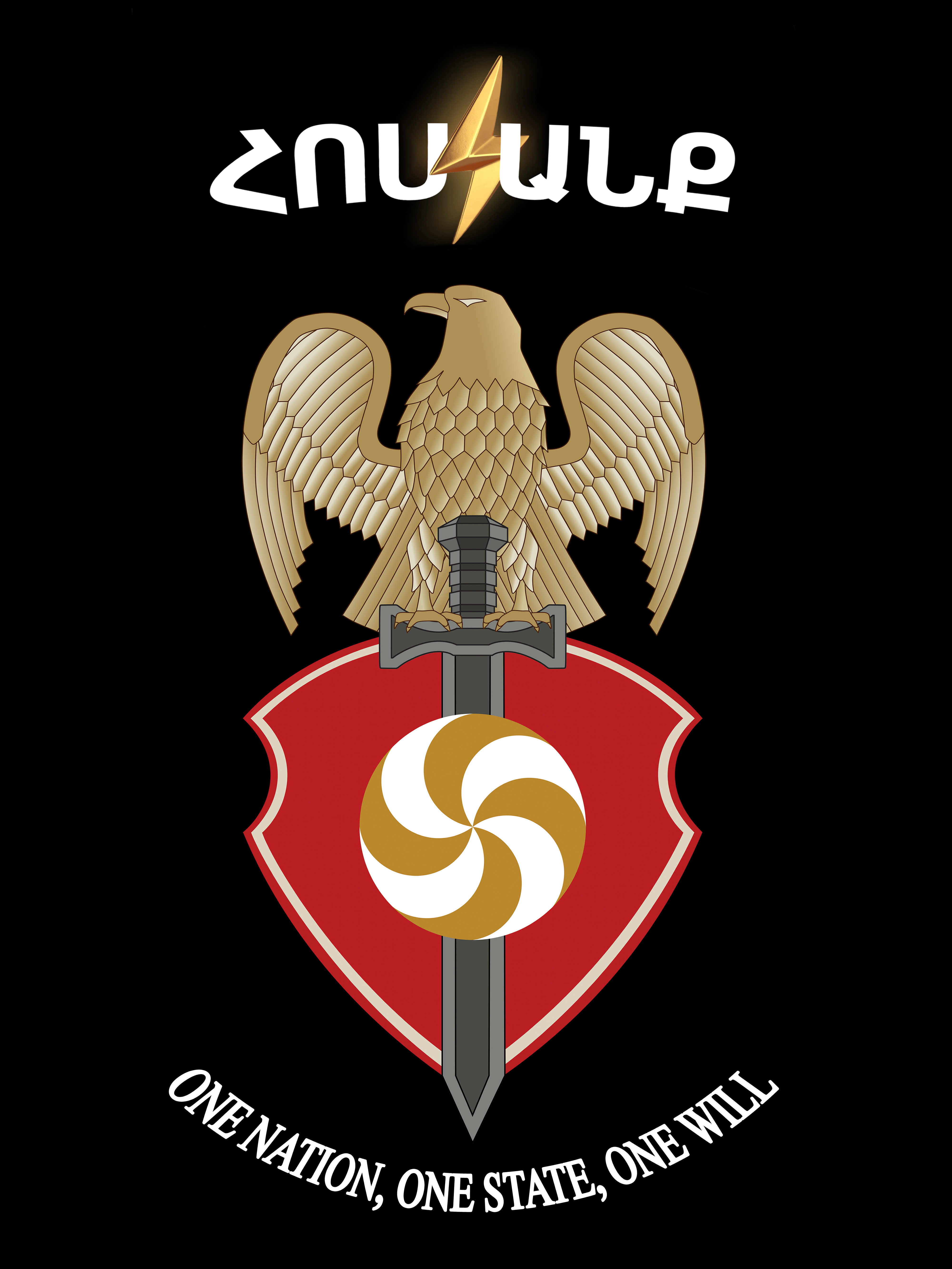
The shield of the “Hosank” emblem symbolizes the defense of our supreme values: nation, fatherland, and independent statehood. The sword represents peace—but peace through the defeat of our enemies and the victory of our armed forces. Above the shield and sword is the Eagle of Taron, gazing westward toward Ararat. It symbolizes that, to fulfill our mission and achieve victory, we must be as the eagle: brave, noble, strong, truthful, wise, just, loyal, far-sighted, determined, and purposeful. The emblem is also a modernized version of the coat of arms created in 1920 by Garegin Nzhdeh for the Republic of Mountainous Armenia—the first explicitly anti-Turkobolshevik Armenian state in history.
In the written version of the “Hosank” symbol, the Armenian word «ՀՈՍԱՆՔ» appears, with a golden lightning bolt in the center. This bolt represents not only literal electricity—the “current”—but also the spark that brings light to humanity, symbolizing “Hosank”’s mission. It also stands for victory, according to German philosopher and mystic Guido von List, who named the ancient Scandinavian “runes” the Armanen runes—perhaps subconsciously sensing that these symbols had very ancient Armenian roots.
Therefore, no movement should adopt names, symbols, or flags arbitrarily, without reason or meaning, as almost all political parties and movements do today. Meaningless symbols give rise to meaningless movements, while meaningful symbols lead to meaningful movements. In short, “Hosank”’s flag is the future flag of a victorious and Aryan Armenian state.
As Nzhdeh said, “Unconquerable is the flag that is raised for the race and in the name of the race,” and we are convinced that he was speaking of the “Hosank” flag.